Earnings · Economy 51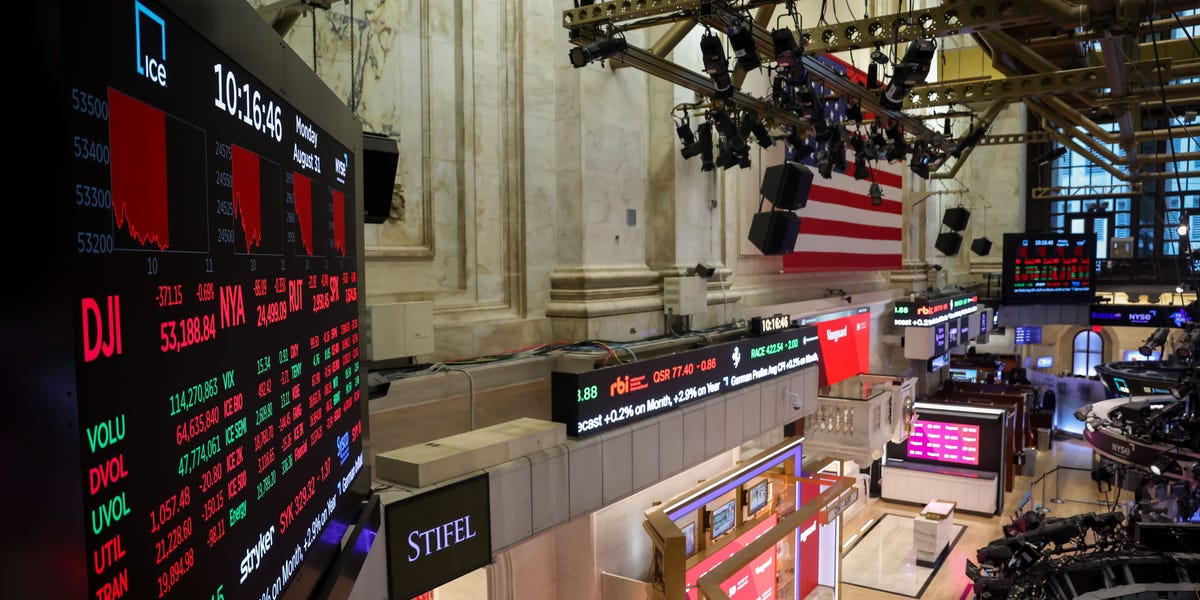
The AI capex boom won't sustain S&P 500 earnings much longer, Goldman says By Samuel O'Brient You're currently following this author! Want to unfollow? Unsubscribe via the link in your email.
NYSE Wall Street has cheered upbeat earnings this year, fueled by strong growth in tech, but the investors shouldn't count on the strong momentum lasting much longer, Goldman Sachs says. Ben Snider, the bank's chief US equity strategist, recently laid out his team's thesis on how AI growth is likely to impact the market in the coming year. Even if capex spending stays strong, he's not convinced it will be enough to sustain this year's positive momentum.
"The AI investment boom has accounted for nearly half of S&P 500 earnings growth this year, and this tailwind should begin to fade next year even as capex spending continues to grow," Snider wrote in a note to investors on Thursday. Snider told Business Insider in July that investors should double down on popular AI infrastructure stocks, citing a bullish stance on the data center boom. Yet, as he looks beyond 2026, his latest view indicates that AI spending may be masking a more difficult reality for markets.
Snider's focus is not on the notion that the AI bubble is likely to burst in the near future. Rather, his base case centers on the likelihood of S&P 500 earnings growth slowing down significantly over the next two years, partially because of problems ahead for chipmakers, which have been major beneficiaries of the AI spending by Big Tech firms. "The recent surge in semiconductor profit margins leaves S&P 500 earnings vulnerable to a decline in chip prices," Snider stated.
"Our industry analysts expect supply to remain tight through 2027 but for the rate of margin expansion to slow next year." Chip stocks have been a significant growth driver for the S&P 500 since the AI boom began in late 2022, surging on the combination of extremely high demand and limited supply. Others have said recently that surging chip costs could be problematic for the AI trade. Goldman previously predicted that the US would shoulder the brunt of a global AI-driven inflation surge, noting that AI chip prices were already troublingly high.
Now, the possibility of cooling chip margins threatens to compromise the momentum that powered the AI trade in 2026. " In a scenario where slowing AI infrastructure investment, increasing supply, and/or technological shift lowers semiconductor prices and profit margins, S&P 500 EPS growth would also disappoint," Snider noted. Snider also highlighted another factor that's helped fuel Big Tech's earnings growth, one that is likely to contribute to the deceleration that his team sees coming: income companies have earned from private investments.
While these paper gains can be considered income, that doesn't mean that the company has actually generated any cash from them. "We expect a much smaller contribution in 2027. The complete removal of this 'other income' next year would create a drag of 8 pp on S&P 500 earnings growth in 2027 relative to 2026, all else equal," Snider added.
Read next Samuel O'Brient You're currently following this author! Want to unfollow? Unsubscribe via the link in your email.
Samuel O'Brient is an experienced financial markets and business journalist who has written extensively on a wide range of topics involving economics, technology and public policy. At Business Insider, he covers important macro and micro economic stories, including takes from leading economists and hedge fund managers , breaking IPOs , corporate bankruptcies , meme stocks and short-selling . He also writes on other markets such as crypto , oil and real estate .He has interviewed many of the market’s most influential voices, ranging from top economists such as Mark Zandi and Richard Thaler to prominent investors including Danny Moses , Andrew Left , Anthony Scaramucci, Louis Navellier and Grant Cardone .
Programs such as LiveNOW from Fox , Taking Stock and Ticker News have had Samuel on to discuss stock market and economic developments. His reporting has been cited by The New York Times DealBook, Bloomberg Radio, Forbes, Entrepreneur, Gizmodo and TheFutureParty. Samuel began at InvestorPlace, covering investing, retail trading and macro economic trends.
Prior to joining Business Insider, he served as a technology markets reporter at TheStreet. He is a graduate of Sarah Lawrence College and Trinity College Dublin. Samuel's work has appeared in publications such as TipRanks, EV and Observer.
When he isn't chasing down stories, he can often be found browsing book and record shops. To reach Samuel, email him at sobrient@insider.com or connect with him on LinkedIn. He is also on Signal as Samuel Clemens.
Investing Wall Street Stocks More Stock Market Goldman Sachs AI Earnings Tech Inflation
Source: Business Insider